
Protecting Homes.
Preserving
Landscapes.
Create a safer perimeter without sacrificing the design, style, or character of your landscape.
What Is Zone 0?
Zone 0 is the first 5 feet around your foundation. Wind-blown embers ignite houses by landing in dry fuel against exterior walls. Keeping this zone clear of combustible materials is the single most effective way to protect your home.
Does it apply to me?
Check if your home is in an official hazard zone using the CAL FIRE Fire Hazard Severity Zone Viewer.
Hardscape only. Nothing combustible against the house.
Low, well-spaced, well-watered plants with no ladder fuels.
Spaced shrubs, limbed-up trees, mowed grasses.
Your First-5-Feet To-Do List
Start with the quick wins this weekend, then plan the upgrades.
Structural Upgrades
Plan AheadA self-audit tool for homeowner reference, not a substitute for an official AB 3074 compliance inspection.
Get Your Free Photo ReviewNot Sure What Needs to Change Around Your Home?
Send us a few details, plus photos of your home’s perimeter if you have them. We’ll deliver a personalized, plain-English action checklist within 48 hours — zero sales pressure, no obligation.
East Bay based · Educational review · Confidential · Delivered within 48 hours
Photo Review request received
Thanks — your photos and property details are in. We’ll review the first five feet around your home for visible ember vulnerabilities and send your personalized action list within 48 hours. There’s no charge and nothing to pay.
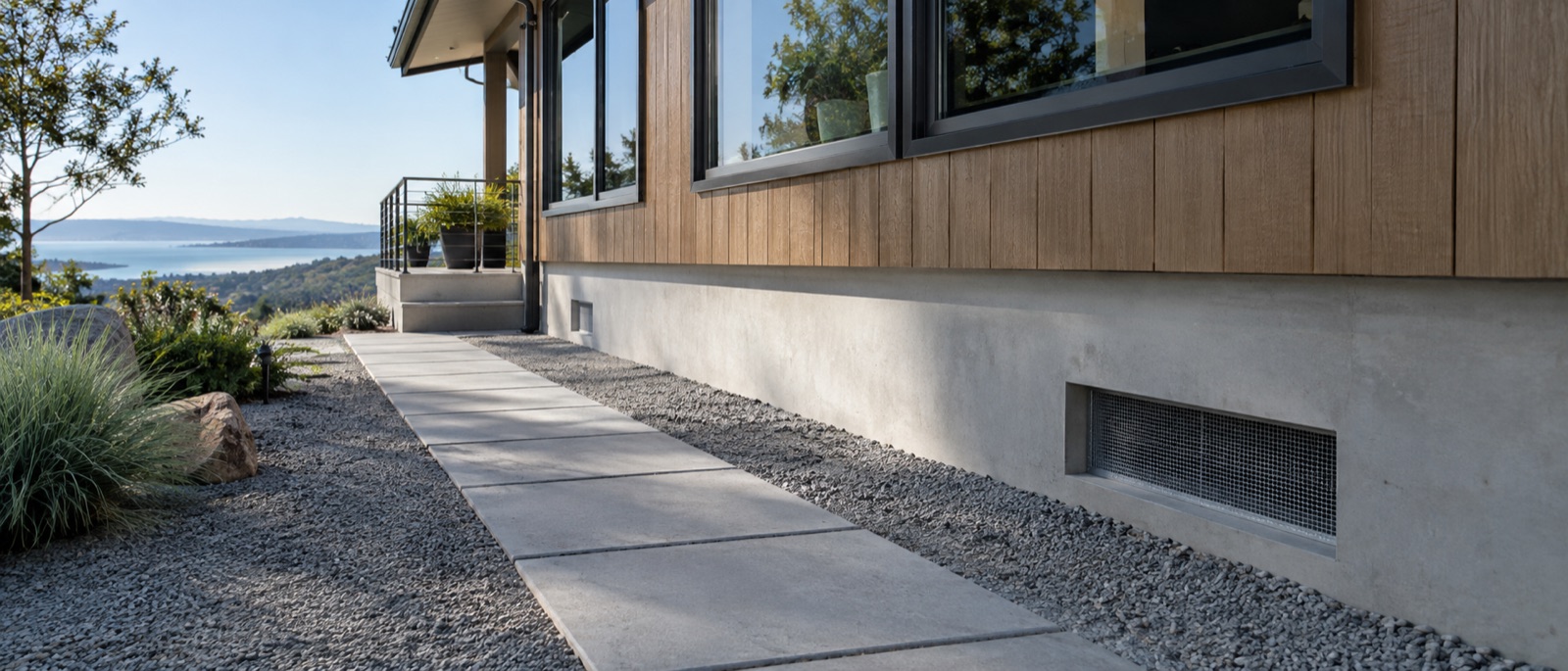
How Embers Turn Small Vulnerabilities Into Ignitions
A home doesn’t have to be touched by the main flame front to ignite. Wind can carry burning embers ahead of a wildfire, and they can enter an opening or land in dry material beside the house. Learn where they get in, then see the materials people commonly use to close those gaps.
The Practical Idea
Reduce the places where embers can enter, collect, or find something easy to ignite. Home hardening lowers risk; it does not eliminate it.
Vents Are Necessary Openings — And Possible Entry Paths
Attic, soffit, gable, and foundation vents release heat and moisture. The same openings can admit wind-driven embers. Torn screens, open edges, and coarse mesh increase the size of the path. Screening or a purpose-built vent can reduce ember intrusion, but any change must preserve the ventilation the building needs.
Why Guidance Points to 1/8-Inch Metal Mesh
Wildfire-preparedness guidance commonly specifies noncombustible, corrosion-resistant metal mesh with openings from 1/16 inch to 1/8 inch. A 1/8-inch screen is finer than common 1/4-inch utility screening, so it can intercept smaller embers while serving as a retrofit screen. It does not stop every ember — embers vary in size, mesh can clog or corrode, and screening does not stop radiant heat or direct flame. Check fit, condition, and required net free ventilation before installation.
The First Five Feet Interrupt the Fuel Path
The area from the structure out to five feet is often called the immediate or noncombustible zone. The goal isn’t simply to spread gravel — it’s to keep embers from finding receptive fuel against walls, under windows, at deck edges, or beside vents. Noncombustible ground cover can help when dry vegetation, wood mulch, leaves, stored items, combustible fencing, and other burnable material are also removed or separated. Maintenance matters, since leaves and needles can collect on top of rock.
A Simple Property Self-Assessment
- Start at the roofline: look for leaves and needles in gutters, roof valleys, and wall-to-roof intersections. Note damaged covers, open tile ends, and visible gaps.
- Map every vent: photograph attic, soffit, gable, crawl-space, and foundation vents. Record dimensions, screen condition, opening size if known, and nearby combustible material.
- Walk the exterior envelope: look at eaves, siding transitions, utility penetrations, windows, doors, and the garage-door edge for gaps or accumulated debris.
- Measure five feet out: mark a five-foot band around the house and attached decks. Note wood mulch, dry plants, doormats, furniture, stored items, fencing, leaves, and anything else that can burn.
- Look beneath and between: check under decks and stairs, in corners, beside planters, and where fencing or other structures connect to the house.
Photos can reveal visible priorities. They can’t confirm hidden construction, code compliance, airflow, or whether a roof or vent assembly is safe to alter. A free Photo Review can help with the visible part.
Learn First, Then Match Materials to the Scope
Photograph and Measure
Use the checklist to document vents, gutters, roof edges, exterior gaps, and the first five feet. Include a ruler or tape measure where dimensions matter.
Build a Priority List
Identify visible places where embers could enter or where dry material could ignite. Separate routine cleaning, focused DIY work, and jobs that may need a qualified contractor.
Compare Common Materials
Review the kits below as examples of what people use for different scopes. Confirm dimensions, airflow, compatibility, and quantities before choosing anything.
A material list should follow the property assessment — not replace it. A kit is useful only when its components, dimensions, and quantities match the actual work.
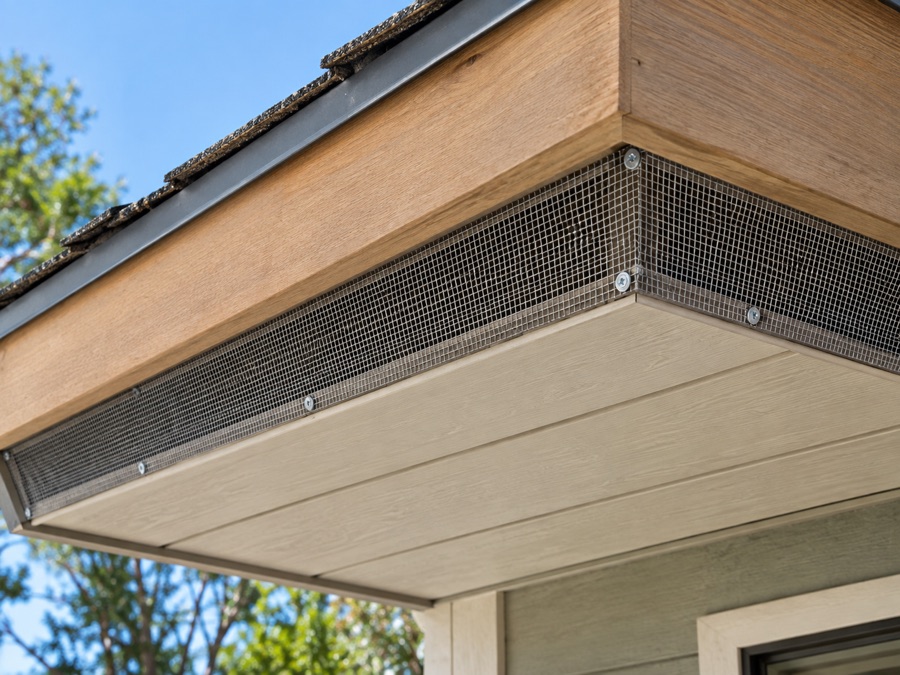
A Small, Well-Defined First Project
Materials often used for compatible soffit openings, small screening tasks, gutter-debris control, and a defined edge. A starting point, not a whole-home solution.
What’s Inside
- 2 × Master Flow 16.5 × 1.5-inch soffit vents with ember-resistant screens, for compatible soffit openings
- 1 × Jackson Wire 1/8-inch mesh roll, 36 in × 10 ft — within the commonly recommended 1/16–1/8-inch range for metal vent screening; fit and required airflow must be checked
- 1 × Frost King mesh gutter guard, 6 in × 20 ft, to help keep dry leaves and needles out of gutters and reduce fuel near the roofline
- Metal landscape edging — final size and specification confirmed before the order
- Illustrated installation guide
Who It’s For
A homeowner whose assessment identifies a few compatible openings and a modest gutter section. Confirm vent type, dimensions, airflow, and safe access before treating this as a DIY project.
Pricing coming soon
See Whether These Materials Fit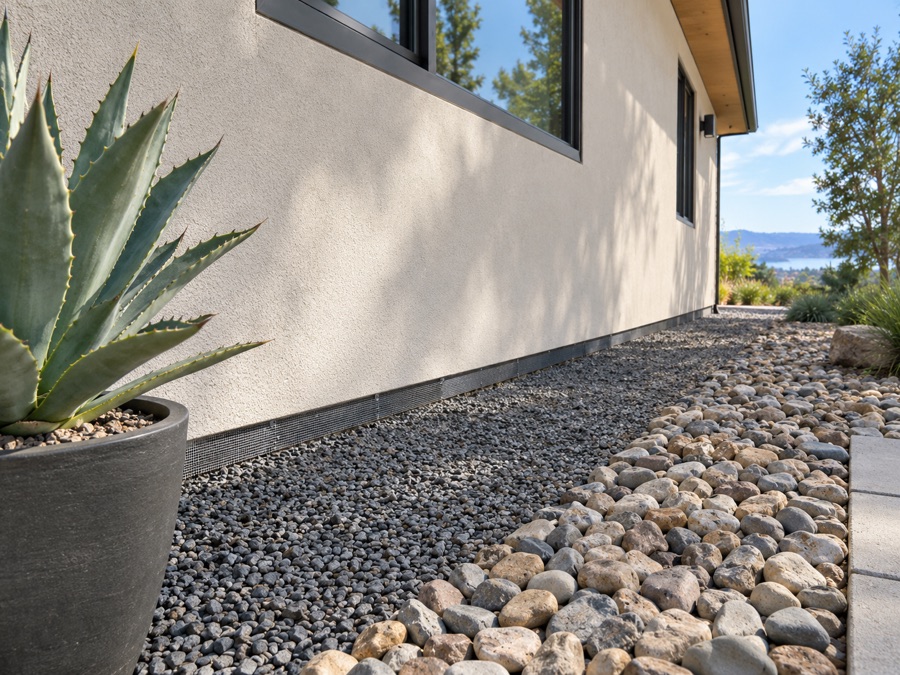
A Broader First-Five-Feet Retrofit
Combines vent, mesh, gutter, ground-cover, and edging materials for a project with several visible priorities. The five-foot zone still depends on removing combustible items and maintaining the area after installation.
What’s Inside
- 2 × Embers Out steel foundation vents, marketed for ember resistance, for compatible foundation openings
- 1 × Jackson Wire 1/8-inch mesh roll, 48 in × 10 ft — within the commonly recommended 1/16–1/8-inch range for metal vent screening; fit and required airflow must be checked
- 1 × WATERLOCK aluminum and stainless gutter guard, 5 in × 28 ft, to help keep dry leaves and needles out of gutters and reduce fuel near the roofline
- Non-combustible ground cover — final material and quantity confirmed from the project scope
- Metal landscape edging — final length and specification confirmed before the order
Who It’s For
A property where the assessment shows several related tasks near the structure. Ground-cover type, depth, drainage, edging, quantities, and vent compatibility must be defined before ordering.
Pricing coming soon
Explore the 5-Foot Materials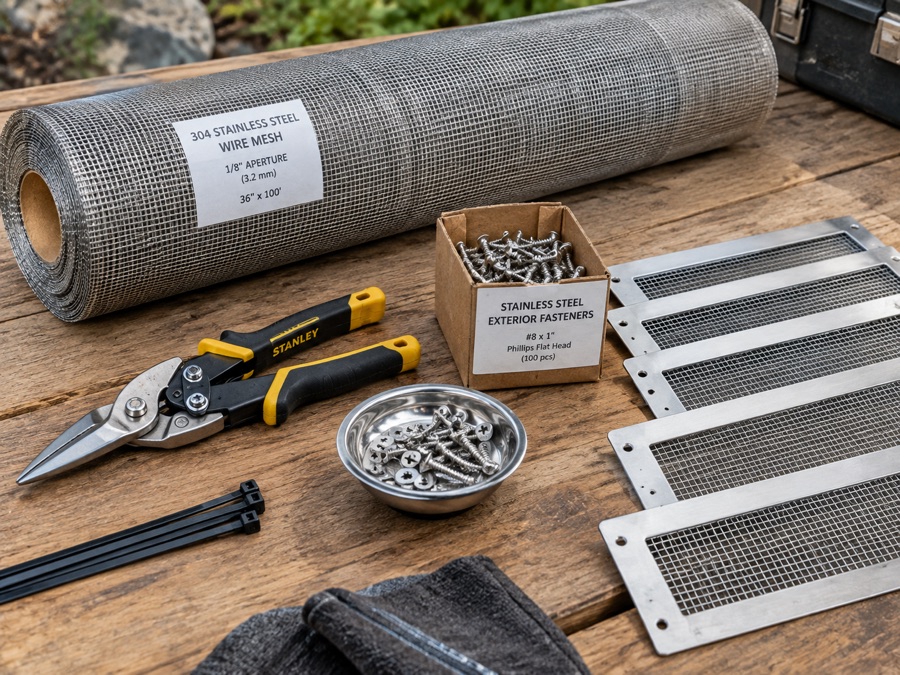
For Work That Repeats Across Projects
Groups bulk screening, compatible vent retrofits, gutter-debris-control materials, fasteners, and flashing for repeated work. Assumes professional scoping, installation judgment, and job-specific verification.
What’s Inside
- 1 × Jackson Wire 1/8-inch mesh bulk roll, 24 in × 100 ft — within the commonly recommended 1/16–1/8-inch range for metal vent screening; fit and required airflow must be checked
- 4 × Embers Out 12 × 12-inch gable vent retrofits, marketed for ember resistance, for compatible openings
- 1 × SKYSHALO aluminum gutter guard package, 104 ft total, to help keep dry leaves and needles out of gutters and reduce fuel near the roofline
- Fasteners and flashing — final types and quantities confirmed before the order
Who It’s For
Contractors completing multiple home-hardening jobs. Product compatibility, detailing, fastener selection, flashing, ventilation, and site safety remain the installer’s responsibility.
Pricing coming soon
Review the Pro MaterialsWe explain what each material is meant to do, where its limits are, and what must be confirmed before use. A photo review is educational guidance, not an official inspection or a promise of protection.
Questions to Understand Before Choosing Materials
How can an ember ignite a home?
Why are vents a concern?
Why 1/8-inch mesh?
What does the five-foot zone actually do?
Are these kits required by law?
Which materials fit my property?
Can I install the materials myself?
Do these materials eliminate wildfire risk?
How do pricing and delivery work?
Start With an Assessment, Not a Shopping Cart
Walk the property, photograph the visible conditions, and measure the areas that may need work. Then use this guide to compare common materials — or ask for help turning the observations into a practical priority list.
Already have a First-5-Feet To-Do List checked off? Use it as the scope — reach out and we can help match the listed tasks to compatible material options and identify what still needs to be measured.
Three principles guide every design and maintenance decision, from the first 5 feet outward.
Create breathing room between plants so your landscape is safer and easier to maintain.
Choose and care for plants that stay healthy, resilient, and appropriate for your property.
Keep the area around your home free of dry leaves, dead material, and other ember-catching debris.
Planting With Purpose
Fire safety and a beautiful property aren't in conflict. Here's how planting, materials, and design work together.
Design Guidance, Not a Plant List
A fire-adapted landscape should do more than reduce fuel. It should create structure, color, texture, and continuity across the property. These reliable plant choices show how placement, spacing, maintenance, and design can work together to create a landscape that is both beautiful and better adapted to wildfire.
Give the landscape shape and backbone. Manzanita 'Dr. Hurd' sheds embers off its smooth bark and needs excellent drainage, avoiding summer irrigation once established. Toyon plays the same role at a larger scale — broad, moist leaves that tend to resist ignition better than many chaparral shrubs, spaced at least 10 ft apart in individual stands.
Bring color and pollinator activity to the landscape. California Buckwheat is fine-textured and tightly packed, a standard choice in defensible-space plantings. California Lilac 'Concha' adds spring blue blooms with dense, moisture-rich foliage when properly spaced.
Soften edges, borders, and containers while keeping planting intentional around the home. Canyon Live-Forever is a compact, moisture-rich succulent well suited to containers. Common Yarrow works as a low-water lawn substitute — mowing it flat helps keep fuel volume low and foliage moisture relatively high.
Tie designed planting into the surrounding landscape. California Sagebrush is fine and aromatic, kept well-spaced from neighboring shrubs. Coast Live Oak, pruned to clear ladder fuel beneath it, brings thick, moist bark.
California Native vs. Traditional Landscaping
| California Native | Traditional Non-Native |
|---|---|
| Minimal water (relies on rainfall) | High water (frequent irrigation) |
| Low maintenance (less pruning/fertilizer) | High maintenance (weekly labor & expense) |
| High wildlife value (attracts pollinators) | Low wildlife value |
Non-Combustible Transitions
Stone, concrete, pavers, gravel, and decomposed granite (DG) create fuel breaks that read as intentional design — not a bare perimeter.
Compliance That Looks Intentional
Pairing architectural stone with drought-tolerant planting keeps a property's character — the goal is a designed landscape, not a stripped one.
Problem → Better Approach
Hover, tap, or focus each card to see a common Zone 0 problem next to a fire-adapted alternative.
 Continuous Planting — Fire Hazard
 Separated Planting — Fire-Adapted
Tap or Hover
Italian Cypress Toyon
 Organic Material Near Home
 Non-Combustible Transition
Tap or Hover
Wood Bark DG & Agave
 Rosemary — Oil-Rich Hazard
 White Sage — Fire-Adapted
Tap or Hover
Rosemary White Sage
 Juniper — Ember-Catching
 Manzanita — Fire-Adapted
Tap or Hover
Juniper Manzanita
Reference Material
Official sources and answers to common questions — everything short of an on-site visit.
FAQ & Official Resources
Regulatory status last verified September 22, 2026
Is Zone 0 final yet? When do these rules take effect?
What's the compliance timeline for existing homes?
What is Assembly Bill 3074 (AB 3074)?
Are bark and wood mulch allowed in Zone 0?
Do I have to remove all plants from the 5-foot perimeter?
Ember-Defense Kits
How can an ember ignite a home?
Why are vents a concern?
Why 1/8-inch mesh?
What does the five-foot zone actually do?
Are the Ember-Defense Kits required by law?
Which materials fit my property?
Can I install the materials myself?
Do these materials eliminate wildfire risk?
How do pricing and delivery work?
Official AB 3074 Text
The legislation itself, via California Legislative Information. The Board of Forestry and Fire Protection approved final implementing regulations on August 19, 2026; the package was later withdrawn from Office of Administrative Law review on September 8, 2026 before taking effect, so there is currently no statewide effective date.
From Assessment to Ongoing Care
Assess
Photo review to identify what needs attention.
Design
A plan that balances Zone 0 requirements with how the property looks and functions.
Landscape
Fire-adapted planting selected and placed by zone.
Maintain
Ongoing lean/green/clean upkeep to keep the work effective.
Contact Us
Questions about Zone 0 clearance, pricing, or your property? Send us a message and we'll get back to you within one business day.
Or call (510) 394-2590.
Want a plan for your property instead?
Get Your Free Photo Review